TechEd Africa 2013: Levels


 In 2010, I wrote a post about how to find the best sessions at TechEd, which is as valid today as it was then—except for one thing, the decoding sessions part:
Every session at TechEd has a code, and this code contains key information that helps you get to the right sessions easily. If I look at one of the sessions I am presenting, the code associated is APS309, but what does that mean?
- APS – This is the track, or the high-level concept that the session is part of. APS, in this case, refers to Application Server. Microsoft has a great guide to all these TLAs (three-letter acronyms) on the technical track page. The only item missing from there is WTB, which stands for Whiteboard (I’ll cover that next).
- 3 – This digit indicates the session’s level, ranging from 1 to 4:
- 1 indicates an introductory session—ideal for attendees with no prior knowledge. Expect a slow pace, broad concepts, and little depth.
- 2 indicates a beginner session—assumes some prior exposure. Covers usage scenarios with moderate pace and depth.
- 3 indicates a technical session—best for those actively working with the tech. Often fast-paced, deep, or exploring new areas.
- 4 indicates a deep-dive session—for advanced attendees only.
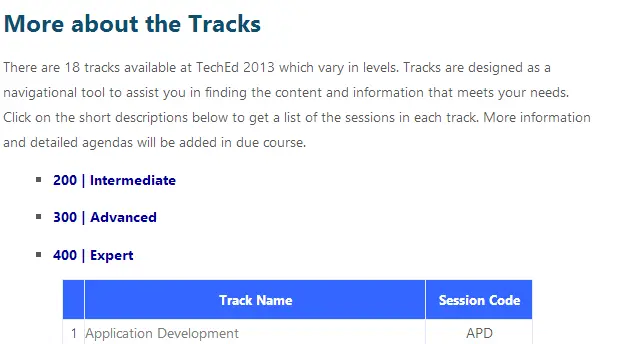
TechEd this year still uses these codes to help you identify talks, but you’ll no longer find level-100 sessions (that first digit). This doesn’t mean introductory sessions are gone—far from it. Instead, Microsoft has reclassified all level-100 sessions as level-200, meaning a 200-level session could still be introductory or beginner-friendly.
This makes the next piece of advice from that post even more critical for selecting the right talks:
The next step is to read the abstract for each topic—it’s the session’s blueprint. Take my example again: the title is Intro to Workflow Services and Windows Server AppFabric, but the abstract reveals deeper details:
- It starts with Workflow Foundation (WF), targeting developers familiar with it.
- Then it covers WF + Windows Communication Foundation (WCF) integration in .NET 4.
- Finally, it addresses AppFabric and hosting.
The abstract clarifies that while the title sounds beginner-friendly, the content assumes more expertise than a true "intro" level. Always read between the lines!
Note: The content of this post has been modified by an AI during migration. The original content has been preserved as much and was originally written without AI.